path encoder
An ambisonic encoder that moves a source along a path, driven by automation and by the audio itself
An ambisonic encoder that moves a source along a path, driven by automation and by the audio itself
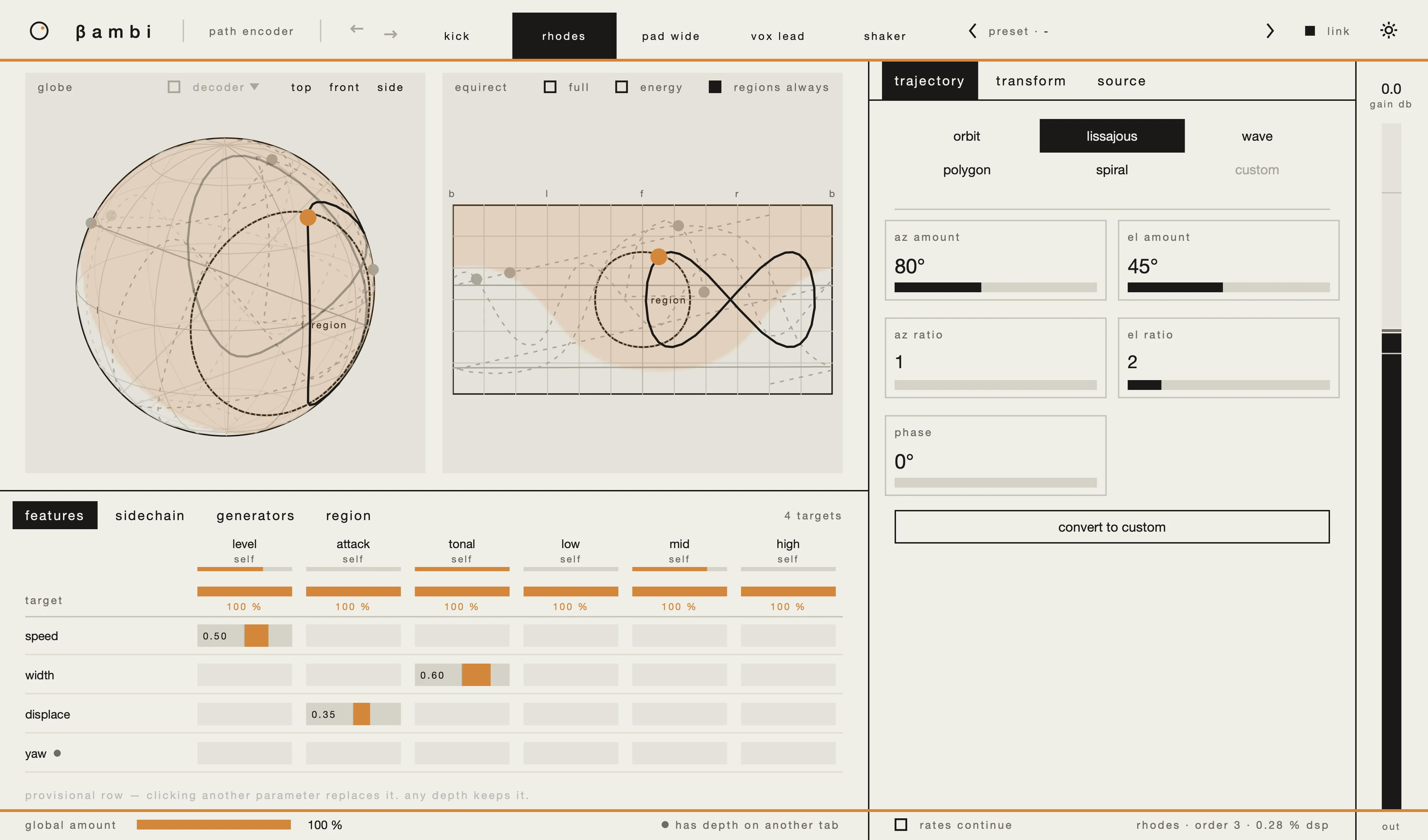
Five shapes — orbit, lissajous, wave, polygon and spiral — each with its own settings, all automatable and modulatable. Or draw your own: custom.
Yaw, pitch and roll, each with a rate for continuous rotation. Extent scales the path: 1 is as drawn, 0 shrinks it to its centre, 2 stretches it through the far side.
Sum encodes the input as one source on the path. Mid/side puts the mid on the path and the side on either side of it; stereo puts left and right on the path, offset from each other. Input trim sets the level before the audio analysis.
Speed sets how fast the source moves along the path, direction which way, and displace its position on the path. Mode sets what happens at the end of the path.
How wide the source sounds, and the range modulation can move the width in.
The path and the source on it, on the sphere and the flat map. Every other encoder in the session is shown in grey.
polygon, click displace, click the cell under attack, and drag it
up.width, click the cell under tonal, and drag.speed to a small value, then click speed and give
it depth under level.The encoding follows the ambisonics literature on the foundations page: the spherical harmonics, ACN ordering and SN3D normalisation, and the max-rE weighting its width is drawn with.